Is Bamboo Fabric Actually Sustainable?
How I became my own product's first correction
James Yoo
Founder and Developer
James Yoo is the founder and developer of Fluven, a free Chrome extension that scores Amazon products on carbon, waste, and ethics at the point of purchase. He writes about the sustainability claims and supply chains behind everyday purchases.
Key Takeaways
- Most 'bamboo fabric' is viscose rayon, not bamboo fiber, made through a chemically intensive process.
- Carbon disulfide used in viscose production is harmful to workers and is released into air and water when not recovered.
- The FTC requires rayon made from bamboo to be labeled as rayon or viscose, not 'bamboo'.
- 'Natural fiber' and 'low environmental impact' are not the same claim.
Most fabric sold as "bamboo" is legally rayon, not bamboo fiber, made through a chemically intensive process that the U.S. Federal Trade Commission has explicitly ruled must be labeled as rayon or viscose. I learned this the hard way, a few days after launching a product built to catch exactly this kind of mislabeling. At Kellogg, one of my professors gave a warning to every founder in the room. Do not build a product that is B2ME, a product that only serves yourself. It is a common failure mode. Founders solve their own narrow problem and mistake it for a market.
Do not build a product that is only for you.
I built Fluven to avoid that trap. But I was still its first customer, and not just for the obvious reason of testing my own product. Just a few days after launch, I forgot I had even built the sustainability-flagging extension. I was just a person trying to buy pajama pants.
A Simple Purchase, An Uncomfortable Flag
I wanted bamboo pajama pants. Two reasons drove the choice. First, bamboo fabric felt soft. Second, I had read about concerns linking microplastics from synthetic fabrics to declining male fertility, and bamboo felt like the safer, more natural alternative.
I searched for bamboo pajama pants. Fluven flagged the results as products with a harmful environmental footprint.
I was confused. Then I did the research my own product had prompted. The word "bamboo" does not mean what most shoppers think it means.
What "Bamboo Fabric" Actually Is
Bamboo is a fast-growing, low-pesticide plant. That part of the story is true. The problem starts at the factory.
Turning bamboo into soft fabric almost always uses a process that produces rayon, not bamboo fiber. Bamboo pulp is soaked in sodium hydroxide, then treated with carbon disulfide to form a spinnable gel, which is pushed through spinnerets to create fiber. This is the standard viscose process, and it is chemically intensive.
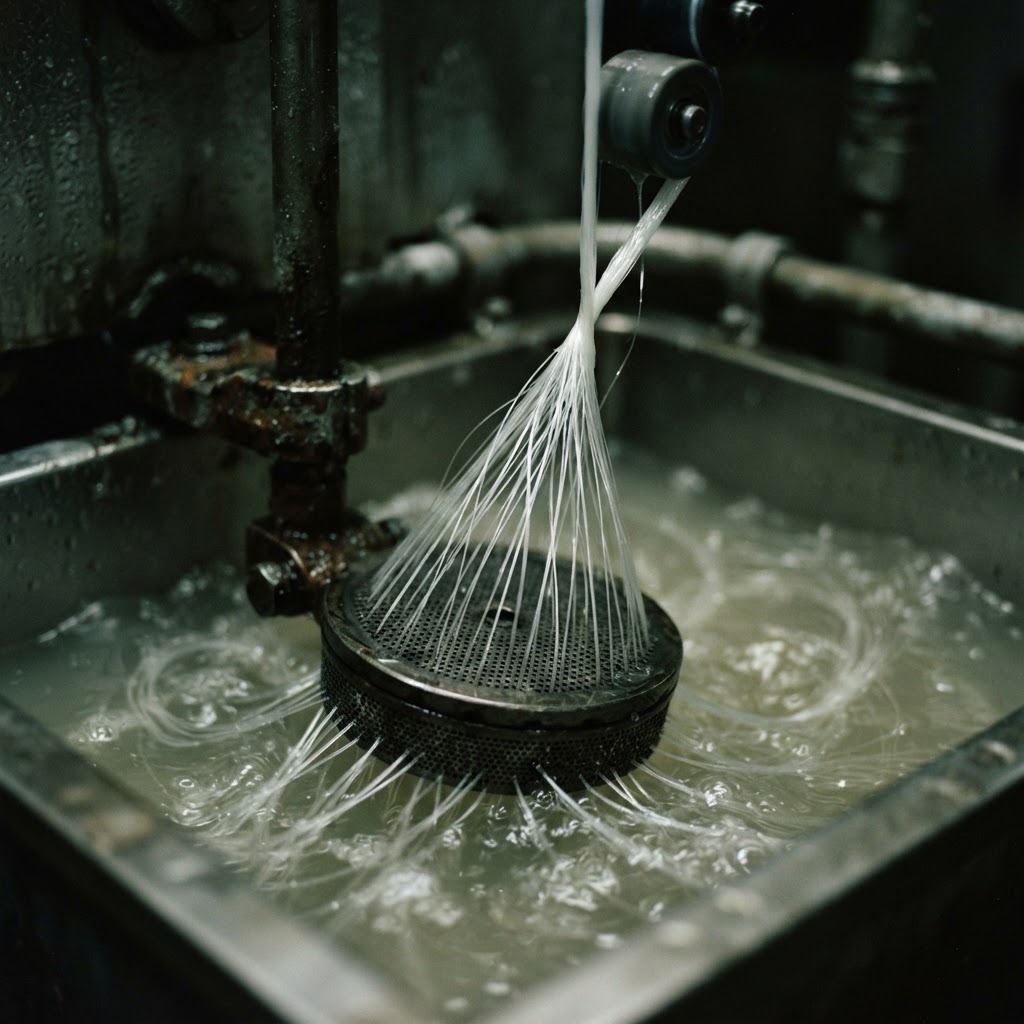
- Carbon disulfide is classified by the CDC's Agency for Toxic Substances and Disease Registry as harmful to the nervous system, cardiovascular system, and eyes at elevated exposure levels (Agency for Toxic Substances and Disease Registry, 2025).
- Incomplete recovery of carbon disulfide during production means the unrecovered portion is commonly released into air or wastewater near manufacturing facilities.
- The finished fiber, regardless of its plant source, is legally rayon, not bamboo.
This is not just a regulatory labeling issue. A peer-reviewed toxicology review of the viscose industry found consistent evidence linking carbon disulfide exposure to peripheral neuropathy, coronary heart disease, and other chronic conditions among viscose factory workers, and it forms part of the scientific basis for occupational exposure limits used worldwide (Gelbke et al., 2009).
The Regulator Already Settled This
This is not a fringe environmental claim. The Federal Trade Commission has enforced this distinction for over a decade.
In 2009, the FTC charged several companies for marketing rayon clothing as "bamboo fiber," including products sold under names like "Pure Bamboo" and "BambooBaby" (Federal Trade Commission, n.d.). In 2010, the agency sent warning letters to 78 major retailers, including Walmart, Target, and Amazon, for the same mislabeling (Federal Trade Commission, 2010). In 2022, the FTC sought its largest-ever civil penalty for bogus bamboo marketing, targeting Kohl's and Walmart.
Combined civil penalty sought by the FTC against Kohl's and Walmart for bogus bamboo marketing in 2022 (Federal Trade Commission, 2022).
Warned by the FTC in 2010, including Walmart, Target, and Amazon, for labeling rayon textiles as bamboo (Federal Trade Commission, 2010).
The FTC's rule is direct: a textile made from rayon, even when bamboo supplied the cellulose, must be labeled as rayon or viscose made from bamboo, not as bamboo (Federal Trade Commission, n.d.).
The Water and Pollution Cost
Beyond labeling and worker health, bamboo viscose carries a measurable water and pollution footprint. A peer-reviewed water footprint study of viscose textile production found a water scarcity footprint of 60.5 cubic meters of water per ton of fabric, with 85.7% of that impact coming from fiber production rather than dyeing or finishing (Zhu et al., 2020). The same study identified carbon disulfide and zinc discharged in spinning wastewater as the largest single contributors to water ecotoxicity in the entire production process (Zhu et al., 2020).
Water scarcity footprint per ton of viscose fabric produced (Zhu et al., 2020).
Share of that water impact coming from fiber production alone, not dyeing or finishing (Zhu et al., 2020).
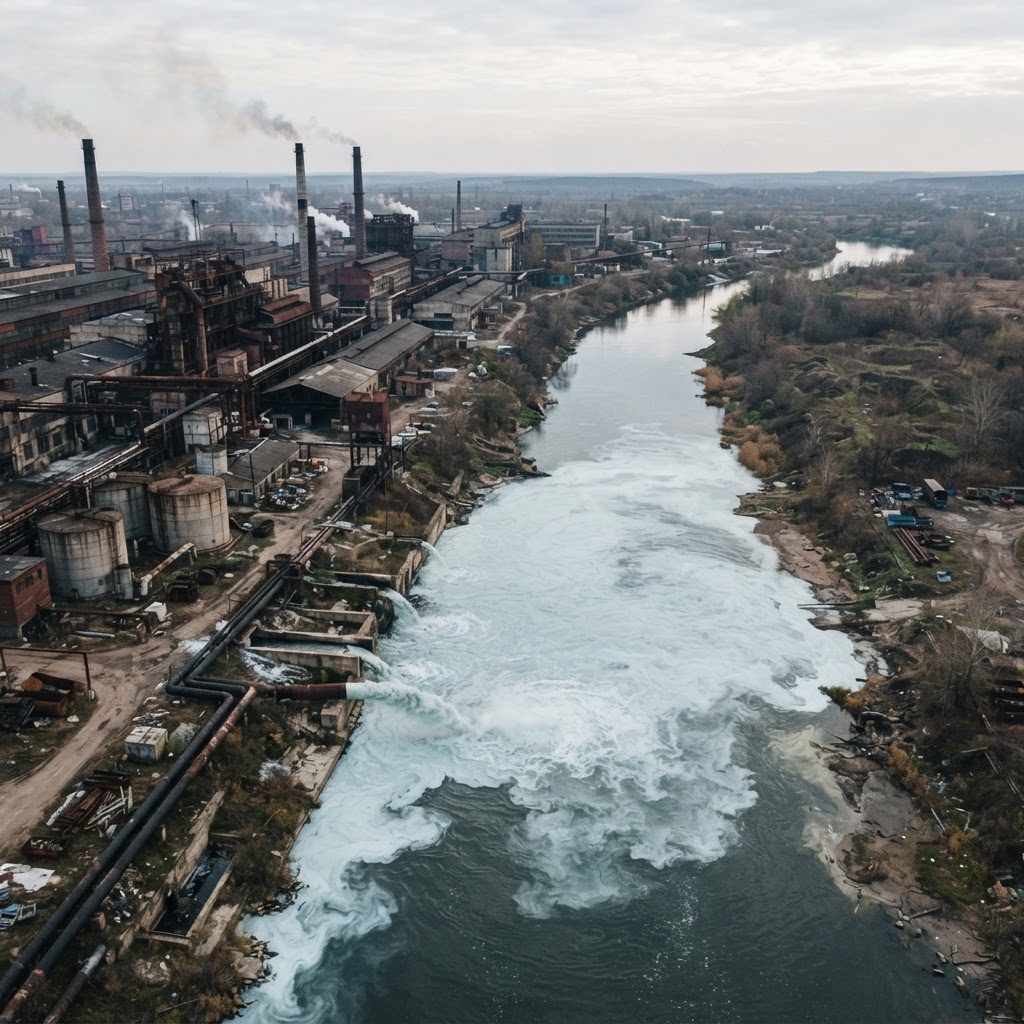
This is not only a laboratory finding. A 2017 field investigation by the Changing Markets Foundation traced untreated viscose wastewater discharge to rivers in India, Indonesia, and China, including the Citarum River in West Java, which the report identified as one of the most polluted rivers in the world (Changing Markets Foundation, 2017). Residents near affected facilities reported abandoning well water over health concerns linked to nearby discharge (Changing Markets Foundation, 2017).
The Part I Got Right, and the Part I Got Wrong
My instinct about synthetic fabric was not baseless. A growing body of research has detected microplastic fibers, many shed from synthetic textiles like polyester, in human testicular tissue and semen (Alex et al., 2025). Animal studies have linked microplastic exposure to reduced sperm count and motility (Alex et al., 2025). The researchers are careful to note that human evidence is still developing, and causation is not yet established, but the concern is grounded in real, peer-reviewed findings.
Where I went wrong was assuming that "bamboo" was a safe answer to that concern. It often is not. Bamboo viscose replaces one set of concerns, plastic shedding, with another, chemical-intensive processing.
The Distinction That Actually Matters
Not all bamboo fabric is made the same way. The processing method, not the plant, determines the environmental cost.
- Bamboo viscose (most common): Uses an open-loop chemical process. Solvents like carbon disulfide and sodium hydroxide are only partially recovered, and the rest exits into the environment.
- Bamboo lyocell: Uses a closed-loop process with a different solvent, typically N-methylmorpholine N-oxide. Manufacturers recover and reuse up to 99.8% of this solvent, sharply reducing chemical waste.
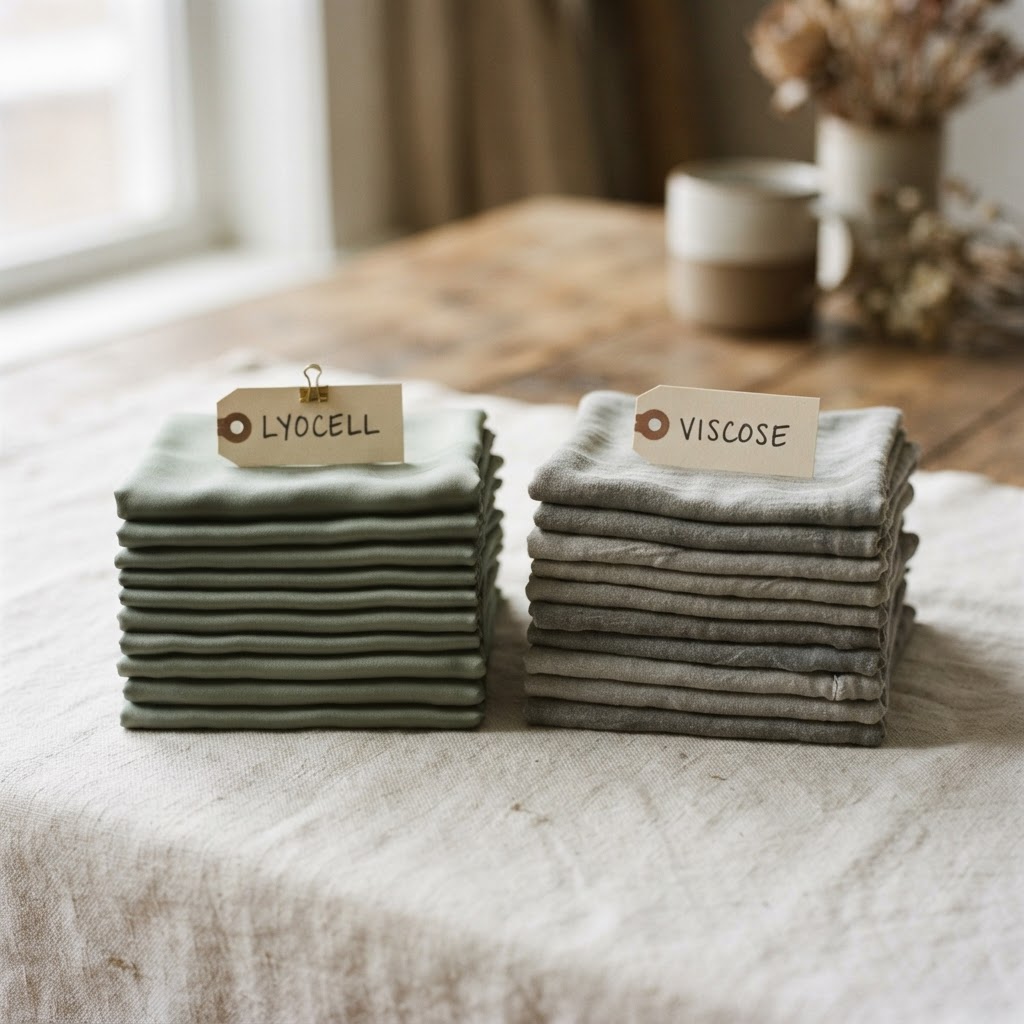
A shopper cannot tell these apart from the word "bamboo" on a label. The fiber type has to be checked directly.
Energy source matters as much as processing method. A 2025 life cycle study of bamboo-based tissue products, a different product category but a useful comparison, found that bamboo fiber itself was not more polluting than wood fiber. The higher carbon footprint of Chinese bamboo tissue came from China's coal-dependent power grid, not from the bamboo plant (Forfora et al., 2025).
Carbon footprint of Chinese bamboo tissue, driven largely by a coal-heavy power grid (Forfora et al., 2025).
Carbon footprint of North American wood tissue on a cleaner electricity grid (Forfora et al., 2025).
The researchers concluded that manufacturing technology and electricity source affect emissions more than fiber choice does (Forfora et al., 2025). The same logic applies to bamboo textile mills, most of which also operate on coal-heavy grids in China and Southeast Asia.
A Practical Takeaway
For anyone shopping for soft, natural-feeling fabric:
- Check the fiber content label for "lyocell" or "Tencel," not just "bamboo."
- Treat "bamboo" on its own as a marketing term, not a fiber name, per FTC labeling rules (Federal Trade Commission, n.d.).
- Look for third-party certification such as OEKO-TEX, which tests for residual processing chemicals.
- Do not assume "natural fiber" and "low environmental impact" are the same claim. They frequently are not.
For Fluven, this was a useful moment of self-correction. A tool built to catch overstated sustainability claims caught its founder's own. That is a sign the underlying model is doing its job, even when the result is personally inconvenient.
A flagging system that only confirms what the founder already believes is not a B2ME product. It is something worse, a product that cannot be trusted.
References
- 1.Agency for Toxic Substances and Disease Registry. (2025). Toxicological profile for carbon disulfide. U.S. Department of Health and Human Services. https://www.atsdr.cdc.gov/toxprofiles/tp82.pdf
- 2.Alex, S. A., George, N. K., Guardiola, J., & Clegg, D. (2025). The threat of micro-/nanoplastics to male fertility: A review of the data and the importance of future research. International Journal of Molecular Sciences, 26(23), Article 11457. https://doi.org/10.3390/ijms262311457
- 3.Changing Markets Foundation. (2017). Dirty fashion: How pollution in the global textiles supply chain is making viscose toxic. https://changingmarkets.org/report/dirty-fashion/
- 4.Federal Trade Commission. (n.d.). Bamboo textiles. Retrieved August 13, 2026, from https://www.ftc.gov/bamboo-textiles
- 5.Federal Trade Commission. (2010, February 3). FTC warns 78 retailers, including Wal-Mart, Target, and Kmart, to stop labeling and advertising rayon textile products as "bamboo." https://www.ftc.gov/news-events/news/press-releases/2010/02/ftc-warns-78-retailers-including-wal-mart-target-kmart-stop-labeling-advertising-rayon-textile
- 6.Federal Trade Commission. (2022, April 8). FTC uses penalty offense authority to seek largest-ever civil penalty for bogus bamboo marketing from Kohl's and Walmart. https://www.ftc.gov/news-events/news/press-releases/2022/04/ftc-uses-penalty-offense-authority-seek-largest-ever-civil-penalty-bogus-bamboo-marketing-kohls
- 7.Forfora, N., Ortega, R., Urdaneta, I., Azuaje, I., Vivas, K. A., Jameel, H., Venditti, R., & Gonzalez, R. (2025). Comparative life cycle assessment of bamboo-containing and wood-based hygiene tissue: Implications of fiber sourcing and conversion technologies. Cleaner Environmental Systems, 19, Article 100337. https://doi.org/10.1016/j.cesys.2025.100337
- 8.Gelbke, H.-P., Göen, T., Mäurer, M., & Sulsky, S. I. (2009). A review of health effects of carbon disulfide in viscose industry and a proposal for an occupational exposure limit. Critical Reviews in Toxicology, 39(sup2), 1-126. https://doi.org/10.3109/10408440903133770
- 9.Zhu, J., Yang, Y., Li, Y., Xu, P., & Wang, L. (2020). Water footprint calculation and assessment of viscose textile. Industria Textila, 71(1), 33-40. https://doi.org/10.35530/IT.071.01.1642
This article was produced with the help of AI and reviewed for adherence to our editorial style guide. It is intended to give directional understanding of a sustainability topic, not to serve as professional, legal, or purchasing advice. Fluven is not responsible for any inaccurate, outdated, or misleading claims that may appear here. If you notice an error, please let us know.
Frequently Asked Questions
Is bamboo fabric really bamboo?+
No. Most bamboo fabric is viscose rayon made by chemically processing bamboo pulp; the finished fiber is legally rayon, not bamboo.
Is bamboo fabric safe and sustainable?+
Viscose production uses carbon disulfide, which harms workers and pollutes water when not recovered; lyocell uses a closed-loop process with far lower chemical waste.
How do I shop for lower-impact bamboo products?+
Look for 'lyocell' or 'Tencel' on the fiber content label and third-party certification like OEKO-TEX, and treat 'bamboo' as a marketing term rather than a fiber name.