Is a Paper Coffee Cup Actually Better for the Environment Than a Plastic One?
Uncovering the hidden lifecycle impacts and chemical realities behind standard beverage containers.
James Yoo
Founder and Developer
James Yoo is the founder of Fluven, a sustainability intelligence platform that scores Amazon products on carbon, waste, and ethics at the point of purchase.
Key Takeaways
- Most paper coffee cups are not recyclable in standard facilities due to the inseparable plastic lining.
- The upstream manufacturing phase is the largest contributor to the global warming potential of single-use cups.
- Both polyethylene and PLA-lined cups release millions of plastic nanoparticles into hot beverages during routine use.
- Reusable alternatives are more sustainable than single-use cups only when used consistently to offset their higher manufacturing burden.
Consumers often perceive paper-based beverage containers as inherently more sustainable than their plastic counterparts. However, the reality is that a single-use plastic cup maintains a global warming potential of 8.12 kgCO2eq per functional unit under baseline conditions, and paper alternatives frequently struggle to offer a lower environmental impact due to complex manufacturing and disposal challenges (Lee et al., 2025). The widespread reliance on these single-use items is staggering, with 5.8 billion cups consumed in South Korean coffee shops and restaurants in 2022 alone (Lee et al., 2025). This equates to roughly 113 cups per person annually, creating a waste management crisis that current recycling infrastructure is ill-equipped to handle (Lee et al., 2025).
Why are paper cups considered unrecyclable?
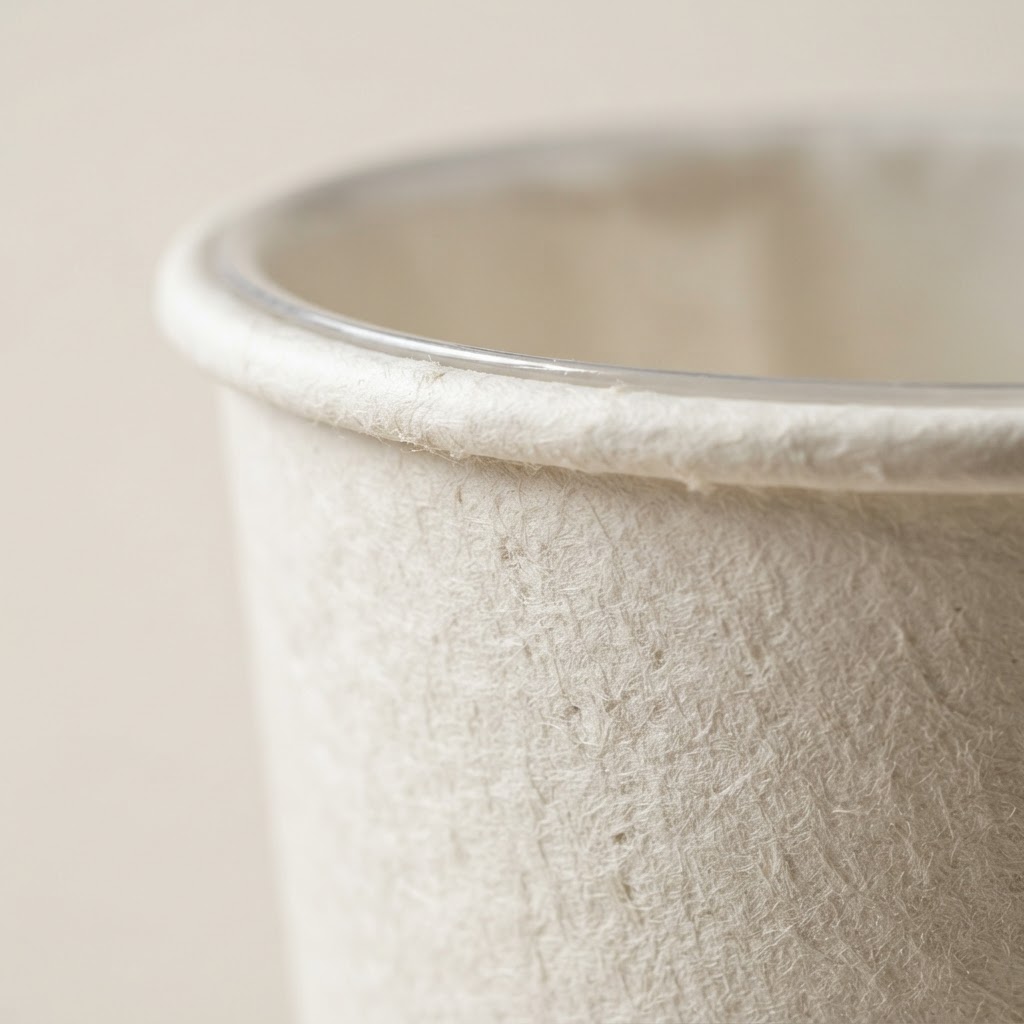
The primary obstacle to recycling paper cups is the necessity of a water-resistant barrier. Most paper cups contain a thin coating of polyethylene (PE) or polylactic acid (PLA) fused directly to the paper fibres to prevent liquid leakage (Shi et al., 2026). This construction creates a composite material that standard curbside recycling facilities cannot process.
Conventional pulping equipment in standard paper recycling plants lacks the capability to effectively separate this plastic lining from the paper fibres. Consequently, despite the paper-like exterior that often features recycling logos, the vast majority of these items are diverted directly to landfills (Lee et al., 2025; Shi et al., 2026). The national recycling rate for these containers remains remarkably low at approximately five percent (Lee et al., 2025).
What are the health implications of lined cups?
Beyond environmental waste, the interior lining of these cups presents a direct pathway for human exposure to synthetic materials. A 2026 study conducted by researchers at the University of Queensland examined the shedding of plastic nanoparticles from various cup types when in contact with hot liquids (Shi et al., 2026).
The results indicated significant contamination levels during routine use. Polyethylene-lined cups released approximately 2.7 million nanoparticles per millilitre of hot liquid (Shi et al., 2026). The situation was more pronounced with polylactic acid linings, which are frequently marketed as a more biodegradable or sustainable alternative (Shi et al., 2026).
The research team at the University of Queensland recorded that PLA-lined cups released approximately 4.3 million nanoparticles per millilitre (Shi et al., 2026). This volume of material represents roughly 12 times more particle mass than that found in the polyethylene-lined samples (Shi et al., 2026).
Are these particles hazardous to human health?
The particles identified in these studies are remarkably small. They are approximately one thousand times thinner than a human hair (Shi et al., 2026). This size range places them in the same scale as small bacteria and large viruses, which complicates their interaction with biological systems (Shi et al., 2026).
Using advanced diagnostic techniques including mass spectrometry, light-scattering analysis, and electron microscopy, researchers confirmed the identity of these materials as genuine plastic particles (Shi et al., 2026). The scientific community has raised concerns regarding the long-term ingestion of micro- and nanoscale plastics, prompting calls for new safety guidelines and standardized labelling requirements for food-contact materials (Shi et al., 2026).
Researchers confirmed that both PE-lined and PLA-lined paper cups release micro- and nanoscale plastic material during routine use with hot beverages and called for regulators to consider safety guidelines and product labelling requirements for food-contact cup linings (Shi et al., 2026).
Where do the highest emissions occur?
Life cycle assessments consistently highlight that the upstream manufacturing phase is the most impactful stage of a single-use cup's life. The Lee et al. (2025) study modelled five distinct scenarios for cup consumption to determine which factors contribute most significantly to global warming potential.
The study concluded that the production of polymers for these cups serves as the single largest contributor to their global warming potential (Lee et al., 2025). This impact far exceeds the emissions generated during the transport or the final end-of-life disposal phase (Lee et al., 2025).
GWP per functional unit for plastic cups
Approximate national recycling rate for paper cups
Increased particle mass release in PLA vs PE linings
What happens if we switch to reusables?
The transition to reusable alternatives is often presented as a complete environmental solution. However, data suggests that the benefits are balanced by new environmental costs. Substituting 25% of single-use cups with reusable versions can lead to a 20% reduction in global warming potential (Lee et al., 2025).
This positive shift comes with trade-offs. The manufacturing of durable items and the energy required for routine cleaning increase specific burdens on land use and mineral extraction (Lee et al., 2025). While reusables generally outperform single-use items in terms of total carbon impact, consumers must commit to high use-frequency to justify these manufacturing investments.
How do regulators view this issue?
Global policy is slowly shifting toward a more nuanced understanding of the impacts of single-use materials. South Korea, for instance, implemented a broad policy response to address these waste streams (Lee et al., 2025).
- Plastic cup ban.The government banned single-use plastic cups in cafes starting 1 April 2022 (Lee et al., 2025).
- Paper cup extension.The restriction was expanded on 24 November 2022 to include paper cups in restaurants and cafeterias (Lee et al., 2025).
- Policy equivalence.These regulations effectively treat both paper and plastic single-use cups with the same level of scrutiny (Lee et al., 2025).
How can consumers make better choices?
Understanding that most paper cups are not recyclable should change your approach to disposable items. Rather than assuming paper is inherently safer or more sustainable, focus on reducing the total volume of single-use items in your daily routine.
Choose high-quality reusables and maintain them for an extended service life to maximize their environmental utility. Before making your next purchase in the drinkware or kitchenware category, use the Fluven platform to check the sustainability score of specific products and ensure you are choosing options that avoid unnecessary synthetic linings or high-carbon manufacturing footprints.
- 1.Lee, C., Lee, H., Jang, Y.-C., & Choi, K. (2025). Comparative life cycle GHG emissions of single-use plastic cups and reusable cups for beverages. Environmental Engineering Research, 30(5), 240722. https://doi.org/10.4491/eer.2024.722
- 2.Shi, Q., Okoffo, E., et al. (2026). Release of nanoplastic and microplastic from polyethylene and polylactic acid lined single-use paper cups. ACS Food Science & Technology. https://news.uq.edu.au/2026-08-takeaway-cups-release-microplastics-your-coffee
This article was produced with the help of AI and reviewed for adherence to our editorial style guide. It is intended to give directional understanding of a sustainability topic, not to serve as professional, legal, or purchasing advice. Fluven is not responsible for any inaccurate, outdated, or misleading claims that may appear here. If you notice an error, please let us know.
Frequently Asked Questions
Can I put paper coffee cups in my standard recycling bin?+
No. Most paper cups contain a plastic lining that cannot be separated from the paper fibres in conventional pulping equipment, meaning they are usually diverted to landfills (Lee et al., 2025; Shi et al., 2026).
Are PLA-lined paper cups better for my health?+
Research indicates that PLA-lined cups may actually release significantly more nanoparticles into hot liquid than polyethylene-lined cups, with some measurements showing roughly 12 times the particle mass (Shi et al., 2026).