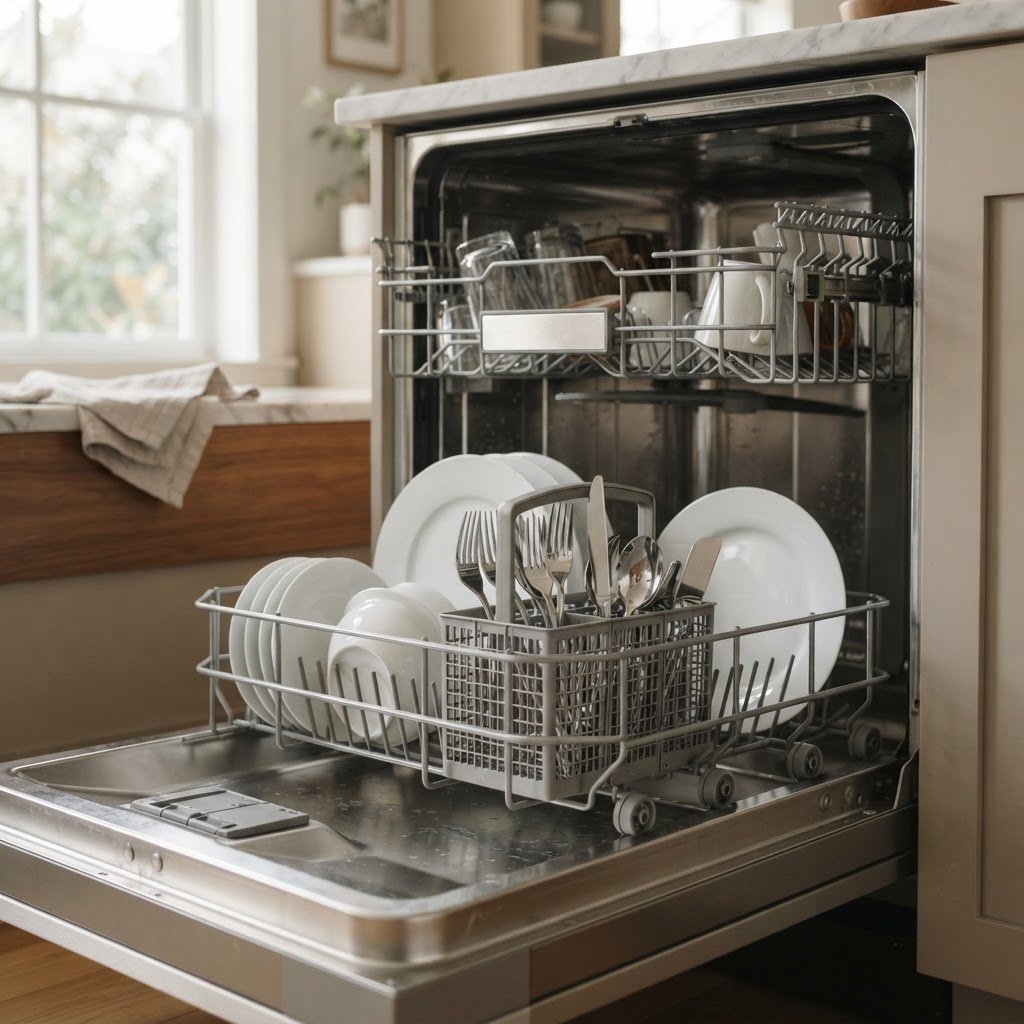
Is Hand-Washing Dishes Actually More Eco-Friendly Than Using a Dishwasher?
Debunking the myth of manual dishwashing efficiency through water and energy metrics.
James Yoo
Founder and Developer
James Yoo is the founder of Fluven, a sustainability intelligence platform that scores Amazon products on carbon, waste, and ethics at the point of purchase.
Key Takeaways
- ENERGY STAR certified dishwashers use significantly less water than manual hand-washing, saving about 5,800 gallons over the machine's lifetime.
- Certified models use no more than 3.2 gallons of water per cycle for standard-size machines.
- Machine washing at 140 degrees Fahrenheit provides better sterilization than hand-washing, which is limited by what the skin can tolerate.
- Energy and water efficiency leads to household savings of approximately $3,300 over the lifetime of a certified dishwasher.
Many households assume that hand-washing dishes is the most environmentally conscious method for cleaning kitchenware. This intuition relies on the belief that a human operator is more precise with water usage than a machine. However, U.S. Environmental Protection Agency data shows the opposite. An ENERGY STAR certified standard-size dishwasher uses no more than 3.2 gallons of water per cycle (U.S. Environmental Protection Agency, 2023).
By comparison, traditional hand-washing habits often involve keeping the faucet running for extended periods, consuming significantly more water. Over the lifetime of an appliance, an ENERGY STAR certified model saves approximately 5,800 gallons of water compared to manual methods (U.S. Environmental Protection Agency, 2023). This discrepancy highlights a fundamental gap between common domestic perception and actual resource consumption.
How do water efficiency standards for dishwashers work?
The ENERGY STAR program provides strict requirements for manufacturers to ensure verifiable resource savings. The current key product criteria, which took effect on July 19, 2023, mandate that a standard-size dishwasher must consume no more than 3.2 gallons per cycle to earn certification (U.S. Environmental Protection Agency, 2023).
These specifications prioritize consistent performance. The criteria apply to both water and energy usage metrics to ensure that performance does not degrade as efficiency increases. Compact models must meet even stricter thresholds, capped at 2.0 gallons per cycle to maintain their certification status (U.S. Environmental Protection Agency, 2023).
Why does the human element cause water waste?
The primary source of waste in manual dishwashing is the tendency to leave the tap running. While a machine is programmed to cycle through specific phases of rinsing and scrubbing, the human operator rarely measures water volume. This lack of feedback loop means that water often flows unnecessarily while dishes are being scrubbed or inspected.
Even when trying to be mindful, hand-washing remains an inherently manual task. It lacks the advanced sensors found in modern appliances that optimize the release of water based on load size and debris level. The efficiency of the machine is built into its hardware, whereas the efficiency of hand-washing remains entirely dependent on individual behavior, which varies drastically across households.
How does energy consumption compare between methods?
Water heating constitutes a major portion of domestic energy demand. Because manual washing often requires the user to heat water on demand for long periods, the energy cost is typically higher than that of a machine. ENERGY STAR certified dishwashers are engineered to heat water efficiently and use it sparingly throughout the cycle.
The latest standards dictate that a certified standard-size unit must consume no more than 240 kWh per year to operate (U.S. Environmental Protection Agency, 2023). These metrics assume a standard benchmark of 215 cycles per year. This predictable energy footprint allows for easier management of household carbon impacts compared to the variable consumption of manual hot water usage.
maximum water per cycle for standard models
maximum energy consumption per year
water saved over machine lifetime
Is there a difference in hygiene?
Sustainability is not just about resource use. It is also about the effectiveness of the cleaning process. The U.S. EPA notes that certified dishwashers boost internal water temperatures to 140 degrees Fahrenheit during the wash cycle (U.S. Environmental Protection Agency, 2023).
This temperature range is rarely achievable or sustainable during manual washing. Hand-washing temperatures must be kept lower to prevent skin burns, which limits the sterilization capacity of the rinse. Therefore, the machine provides a superior sanitary outcome while using fewer resources.

What are the financial implications for households?
The decision to use a high-efficiency appliance extends beyond resource conservation to direct financial savings. The U.S. EPA suggests that switching from manual washing to a certified unit can reduce household utility bills by approximately $220 annually (U.S. Environmental Protection Agency, 2023).
When projected over the typical lifetime of a dishwasher, these savings amount to roughly $3,300 (U.S. Environmental Protection Agency, 2023). These figures demonstrate that the most sustainable choice is often the most economically rational choice as well. Efficiency reduces both ecological degradation and household overhead.
How can consumers optimize dishwasher usage?
- Full loads only.Always wait for a full load before running the cycle to maximize the water per dish ratio.
- Skip the rinse.Modern detergents and machines are designed to handle food particles, making pre-rinsing unnecessary.
- Select the right cycle.Utilize eco-settings or standard cycles rather than heavy-duty modes when the dish soil level is low.
Are there environmental costs to machine manufacturing?
One might argue that the manufacturing of a machine carries an environmental burden. While appliance production does entail material extraction and carbon emissions, the operational phase of a dishwasher is typically the most resource-intensive aspect of its life cycle.
By opting for an ENERGY STAR certified model, the lifetime savings in water and energy help to offset the initial impacts of production. Efficient resource consumption over many years remains the most significant lever for reducing the long-term impact of kitchen operations.

The data from the EPA is clear: replacing hand-washing with an ENERGY STAR certified dishwasher saves roughly 5,800 gallons of water over the machine's lifetime (U.S. Environmental Protection Agency, 2023).
What does this mean for your home?
Sustainability requires us to look past traditional assumptions and examine the actual impact of our daily habits. While scrubbing dishes by hand feels industrious and careful, the data confirms it is a less efficient method for resource management.
For consumers looking to improve their environmental footprint, upgrading to a high-efficiency dishwasher represents a measurable improvement in both water conservation and hygiene. Before purchasing any new kitchen appliance, consider checking its specific sustainability score on Fluven to verify its impact and efficiency rating compared to other available market options.
- 1.U.S. Environmental Protection Agency. (2023). Dishwashers. ENERGY STAR. https://www.energystar.gov/products/dishwashers
- 2.U.S. Environmental Protection Agency. (2023). Dishwashers key product criteria. ENERGY STAR. https://www.energystar.gov/products/dishwashers/key_product_criteria
This article was produced with the help of AI and reviewed for adherence to our editorial style guide. It is intended to give directional understanding of a sustainability topic, not to serve as professional, legal, or purchasing advice. Fluven is not responsible for any inaccurate, outdated, or misleading claims that may appear here. If you notice an error, please let us know.
Frequently Asked Questions
Is it really true that hand-washing wastes more water?+
Yes, standard hand-washing techniques often involve keeping the faucet running, which consumes far more than the 3.2-gallon limit required for ENERGY STAR certified dishwashers.
Are there additional benefits to using a dishwasher?+
Beyond saving water and energy, certified dishwashers boost temperatures to 140 degrees Fahrenheit, which provides a more effective disinfection process than manual methods.