Is a Bamboo Cutting Board Actually More Sustainable Than a Plastic One?
Uncovering the hidden resins and microplastic realities behind your kitchen staples.
James Yoo
Founder and Developer
James Yoo is the founder of Fluven, a sustainability intelligence platform that scores Amazon products on carbon, waste, and ethics at the point of purchase.
Key Takeaways
- Most bamboo boards are engineered composites held together with formaldehyde-based resins.
- All bamboo cutting boards sold in the US must meet specific EPA formaldehyde emission standards.
- Wooden boards release more total microparticles than plastic, though these particles are biodegradable.
- Durability is a major factor in sustainability; a board that lasts ten years is better than one that lasts two.
- Microplastic shedding occurs with both plastic and wood, though plastic particles persist longer.
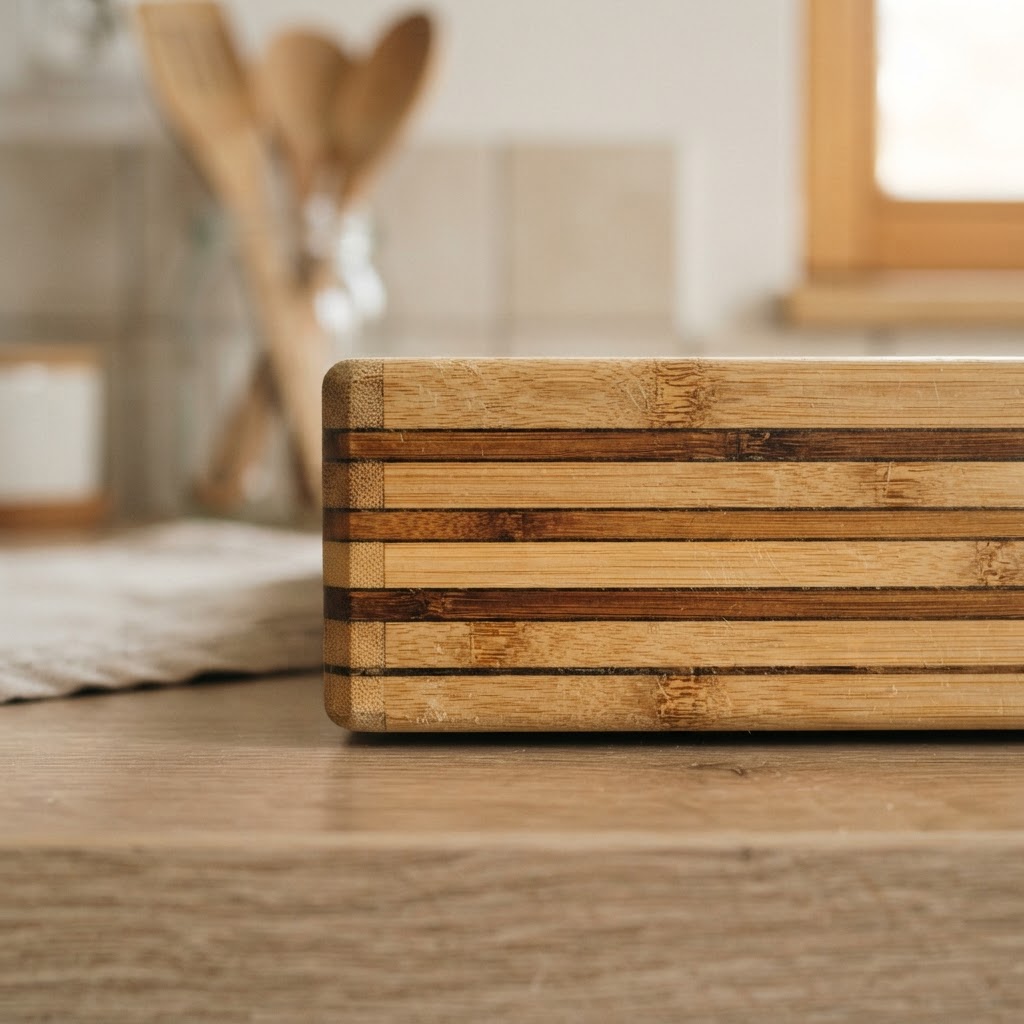
The choice between bamboo and plastic cutting boards involves competing environmental trade-offs. While bamboo is a rapidly renewable resource, most commercial bamboo cutting boards are engineered composites that contain formaldehyde-based resins. A 2023 study found that wood-based boards can release 4 to 22 times more microparticles than plastic boards, though these wood particles are biodegradable unlike their petroleum-derived counterparts (Iskander et al., 2023).
Consumers often select bamboo under the assumption that it represents a natural, plastic-free alternative to synthetic boards. The manufacturing process often relies on bonding thin bamboo strips with urea-formaldehyde or melamine-formaldehyde adhesives. This technique mirrors the production of particleboard and medium-density fiberboard (U.S. Environmental Protection Agency, 2016).
Are bamboo boards considered composite wood products?
Yes, the regulatory framework governing building materials applies directly to these kitchen tools. The U.S. Environmental Protection Agency (2016) classifies bamboo cutting boards manufactured with specific resin binders as composite wood products. This brings them under the oversight of the Formaldehyde Standards for Composite Wood Products Act of 2010.
Under current regulations, these products must adhere to stringent emission limits to protect consumers from indoor air quality degradation. The EPA established these rules to monitor and limit the amount of formaldehyde that off-gasses from finished goods into living spaces (U.S. Environmental Protection Agency, 2016).
Formaldehyde is a known human carcinogen. Exposure is primarily linked to the inhalation of vapors released from composite materials over time (U.S. Environmental Protection Agency, 2024). Buyers should verify that any bamboo product they purchase is explicitly labeled as TSCA Title VI compliant.
Do wood boards actually shed more microplastics than plastic boards?
Recent research challenges the common narrative that plastic boards are the primary source of microplastic contamination in the kitchen. In a 2023 study, investigators observed that wooden cutting boards released significantly higher counts of microparticles compared to high-density polyethylene and polypropylene boards (Iskander et al., 2023).
The particle release from wood was measured at 4 to 22 times higher than that of plastic under various testing conditions. While the volume of particle shedding is higher, the chemical composition differs fundamentally. Wood-derived particles are organic and undergo biodegradation when released into the environment (Iskander et al., 2023).
In contrast, plastic boards contribute to the accumulation of non-biodegradable synthetic polymers. The same study estimated that polyethylene boards can release between 14 and 71 million particles annually, while polypropylene boards may release up to 79 million particles (Iskander et al., 2023).
What is the environmental cost of durability?
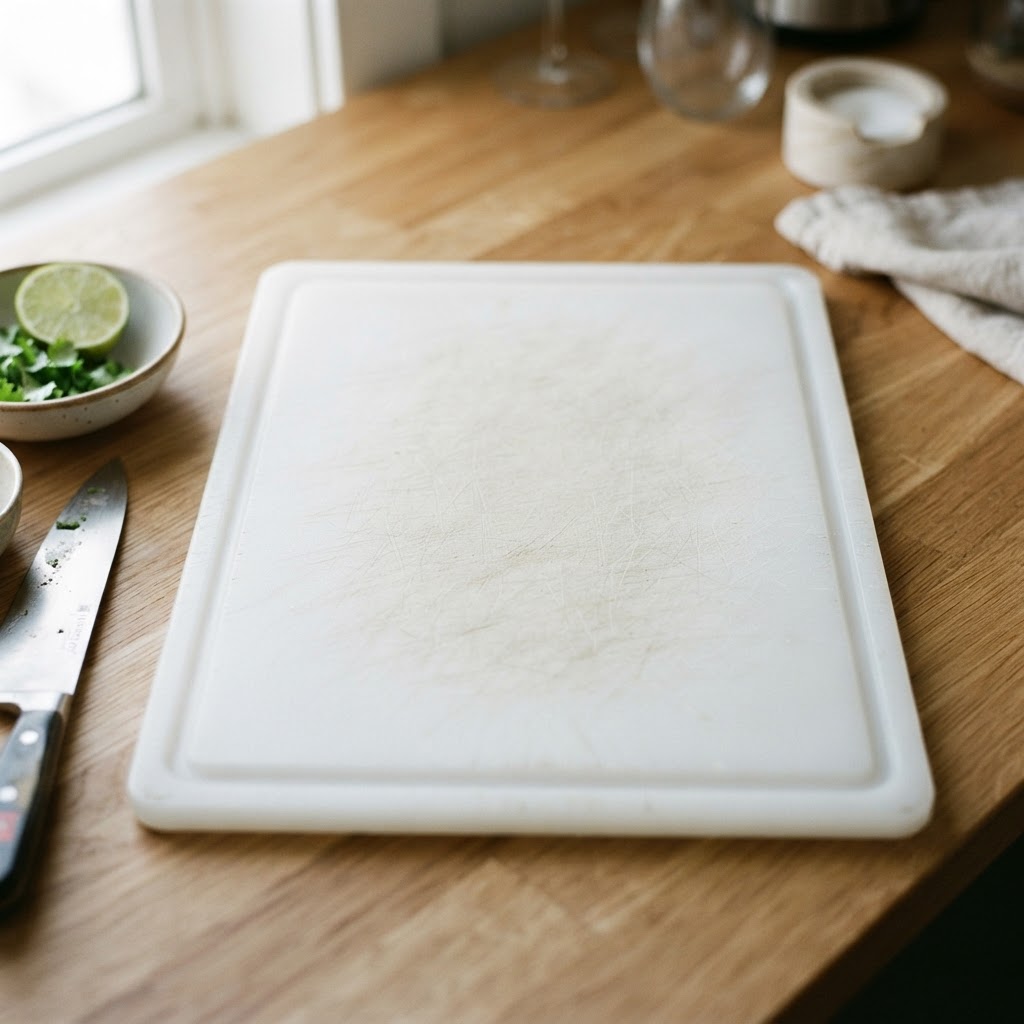
Durability remains a crucial metric for evaluating the sustainability of any kitchen tool. Plastic cutting boards, particularly those made from high-density polyethylene, offer significant longevity. They are often dishwasher-safe and can be resurfaced by planing to remove knife scars, allowing them to remain in service for decades (U.S. Food and Drug Administration, 2023).
Bamboo boards, despite their status as a natural material, often face a shorter service life in high-traffic kitchens. Poorly made bamboo boards can delaminate, split, or warp due to frequent moisture exposure. Once a wooden board reaches this state, it is often discarded rather than repaired (U.S. Environmental Protection Agency, 2016).
Manufacturing impacts are amortized over the total number of years a product stays in use. A board that lasts for ten years will carry a significantly smaller annual footprint than one that must be replaced every two years. Material sourcing is only one part of the equation.
How do manufacturers adhere to safety standards?
Regulatory compliance is not optional for companies importing composite bamboo products into the United States. Since 2019, all such goods must meet the EPA emission standards set forth in the TSCA Title VI final rule (U.S. Environmental Protection Agency, 2016).
This compliance ensures that manufacturers maintain strict oversight of the resins used in bamboo strip bonding. While this regulation limits formaldehyde off-gassing, it also confirms that the products are essentially a form of engineered wood rather than raw, natural timber. Understanding this distinction is vital for informed purchasing decisions.
Are there health risks associated with formaldehyde?
Formaldehyde exposure represents a documented health risk. The EPA characterizes formaldehyde as a known human carcinogen based on extensive risk evaluations conducted under the Toxic Substances Control Act (U.S. Environmental Protection Agency, 2024).
While indoor air concentrations from a single cutting board are typically low, cumulative exposure from various household products can increase risk. Air circulation and product quality are two variables that dictate the concentration of pollutants in a residential environment.
Composite wood products are one of the primary sources of formaldehyde found in household products, and the primary exposure pathway is breathing air containing off-gassed formaldehyde from these products (U.S. Environmental Protection Agency, 2024).
How does product longevity change the sustainability narrative?
The lifecycle sustainability of a kitchen board is heavily dependent on maintenance habits. A plastic board that is properly maintained and kept in circulation for ten years performs favorably in a lifecycle analysis compared to a frequently replaced wooden board.
Environmental performance is not determined solely by the raw material. It is determined by the total impact of production, shipping, and the eventual disposal of the item after it reaches the end of its functional life.
Consumers often prioritize natural materials, yet longevity provides a more effective path to waste reduction. Opting for higher-quality boards, regardless of material, can reduce the frequency of new purchases and the associated resource demand.
What does this mean for your kitchen?
Sustainability is rarely a binary choice between materials. Choosing a board requires an evaluation of your personal use patterns, your tolerance for microparticle release, and your willingness to maintain the product over time. Before you make your next purchase, check the product's Fluven score to see how its material sourcing and lifecycle sustainability ratings compare to other kitchenware options.
- 1.Iskander, S. M., Grennan, M., Azimov, U., Arega, Y., & Bhattacharya, P. (2023). Cutting boards: An overlooked source of microplastics in human food. Environmental Science & Technology, 57(23), 8549–8560. https://doi.org/10.1021/acs.est.3c00949
- 2.U.S. Environmental Protection Agency. (2016). Formaldehyde emission standards for composite wood products (TSCA Title VI final rule). Federal Register, 81(247). https://www.epa.gov/formaldehyde/formaldehyde-emission-standards-composite-wood-products
- 3.U.S. Environmental Protection Agency. (2024). Facts about formaldehyde. https://www.epa.gov/formaldehyde/facts-about-formaldehyde
This article was produced with the help of AI and reviewed for adherence to our editorial style guide. It is intended to give directional understanding of a sustainability topic, not to serve as professional, legal, or purchasing advice. Fluven is not responsible for any inaccurate, outdated, or misleading claims that may appear here. If you notice an error, please let us know.
Frequently Asked Questions
Are bamboo cutting boards completely plastic-free?+
No. While bamboo is a natural material, the strips are typically bonded with urea-formaldehyde or melamine-formaldehyde resins, making them a type of composite wood product.
Do I need to worry about formaldehyde in my kitchen?+
Products sold in the U.S. must comply with EPA TSCA Title VI standards, which limit formaldehyde off-gassing. You should look for labels confirming that your bamboo product meets these regulations.